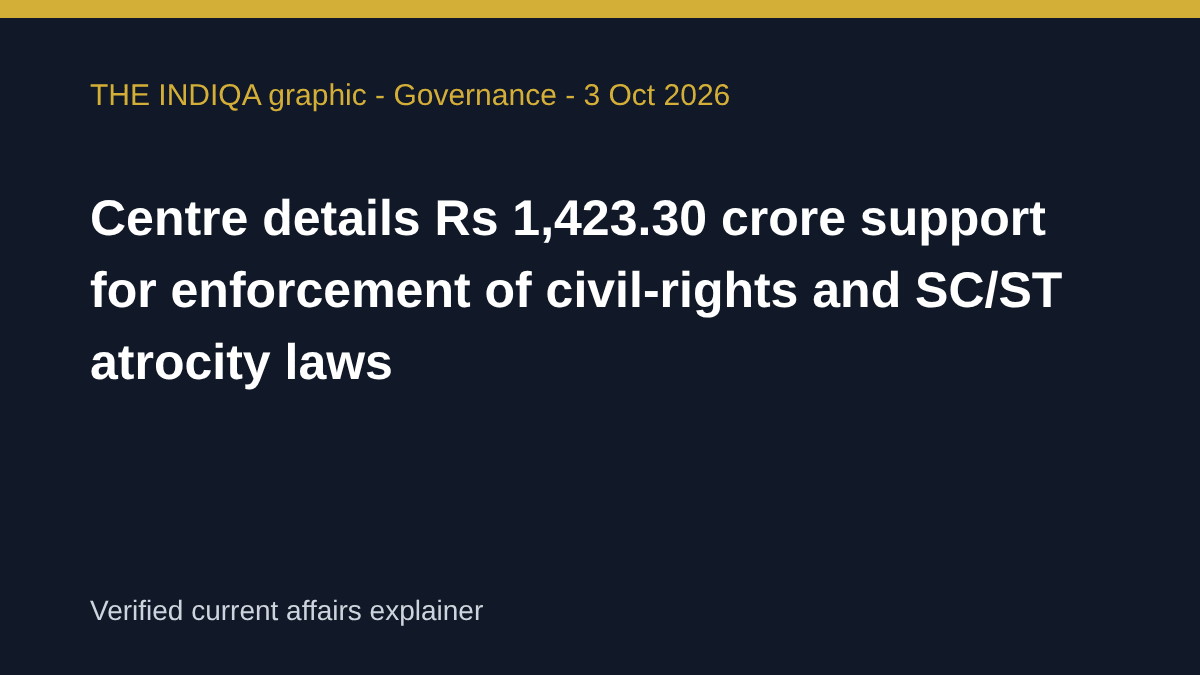
PoliticsCentre details ₹1,423.30 crore support for enforcement of civil-rights and SC/ST atrocity laws
The latest implementation update focuses on special courts, victim relief and rehabilitation, awareness and grievance mechanisms, while the primary enforcement responsibility remains with States and Union Territories.
THE INDIQA Research DeskPublished 3 Oct 2026Updated 3 Oct 20261 min read
The Ministry of Social Justice and Empowerment said the Union government released ₹1,423.30 crore in Central assistance to States and Union Territories over three financial years for implementation of the Protection of Civil Rights Act, 1955 and the Scheduled Castes and the Scheduled Tribes (Prevention of Atrocities) Act, 1989.
The support is meant to strengthen enforcement machinery, special courts, relief and rehabilitation for victims, awareness of statutory safeguards and grievance redressal. The ministry also underlined an important federal point: implementation of the two laws primarily rests with State governments and Union Territory administrations.
This makes the story an example of how a central law depends on state-level institutions. Statutory offences and safeguards can be defined nationally, but outcomes depend on police registration and investigation, prosecution capacity, functioning of courts, timely relief, witness and victim support and administrative monitoring.
For civil-services preparation, the useful distinction is between the legal framework and implementation capacity. The announced allocation is evidence of government support for the enforcement system; it should not be read as proof that offences have declined or that every victim receives timely justice. Those outcome questions require separate crime, court and implementation data.
CIVIL SERVICES VIEWStudy this development
GS-IIMechanisms, laws and institutions for protection and betterment of vulnerable sectionsPrelims: HighMains: HighAdvanced
Why this matters
The Social Justice Ministry published an implementation update stating that ₹1,423.30 crore in Central assistance was released over three financial years.
Key facts
- The Protection of Civil Rights Act dates to 1955.
- The SC/ST (Prevention of Atrocities) Act dates to 1989.
- The ministry states that primary implementation rests with States and UT administrations.
Key terms
- Protection of Civil Rights Act 1955
- SC/ST (Prevention of Atrocities) Act 1989
- special courts
- victim relief
Arguments, challenges and policy responses
- Centre-State implementation responsibilities
- Access to justice and victim support
- Capacity of special courts and prosecution
India’s context
The update highlights the administrative chain required to translate anti-discrimination and atrocity laws into enforceable protection.
Keep in mind
Central financial assistance is not an outcome measure and does not establish whether atrocity incidence or case pendency has fallen.
Practice question
Why does effective social-justice legislation require institutional capacity beyond the enactment of a law?
Revision summary
- The update illustrates a core federal implementation problem: national legal safeguards depend on state policing, prosecution, courts, relief systems and monitoring.
- The Protection of Civil Rights Act dates to 1955.
- The SC/ST (Prevention of Atrocities) Act dates to 1989.
DISCUSSION & EDITORIAL REVIEW
Join the discussion
Comment on the story, report a factual or editorial issue, or tell us whether the article was useful.
Comments
Public comments appear after editorial review.